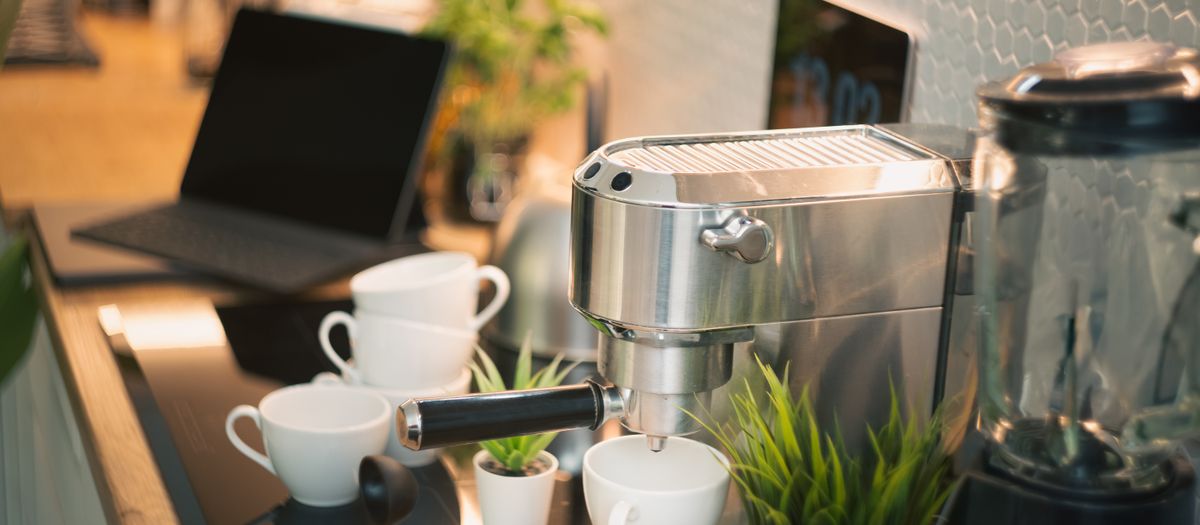
Every espresso buying guide leads with boilers, pumps and PID. Almost none of them mention the thing that actually trips people up on day one: where the machine goes, and whether you can even use it where you put it. I’ve shuffled my setup around more than once, so here’s the unglamorous reality check.
Footprint is only half the problem — height is the other half
Machines list their width and depth, and people dutifully measure their counter for those. Then the box arrives and the lid won’t open because there’s a cabinet ten inches above the counter.
You need clearance for three things, not one:
- The footprint itself, plus a little breathing room around it — these machines get warm.
- The height to open the top lid and refill the water tank. Many machines fill from the top, and if a cabinet sits above your counter you can’t lift the lid.
- The height and reach to swing the portafilter and steam wand without smacking a cabinet or the backsplash.
Measure the gap above the counter, not just the counter. That single check saves a lot of returns.
The water tank decides a surprising amount
Most home machines have a refillable water tank. Where it fills from, and how big it is, shapes your daily life more than the spec sheet suggests. A small tank that fills from the top, tucked under a cabinet, means pulling the whole machine forward to refill — every couple of days, forever. A tank you can refill from the front, or pull out from the side, is a small luxury you’ll appreciate every single week.
Do you need plumbing? Almost certainly not
Some prosumer machines can be plumbed in — connected directly to your water line so you never fill a tank, with a drain line so you never empty a tray. It sounds great, and for a café or a heavy household it’s brilliant.
For the vast majority of home baristas, it’s overkill, and it locks the machine to one spot near a water connection. A tank machine you can move, clean behind and take with you when you move house is the more flexible choice. Don’t let “plumbable” pull you toward a bigger, pricier machine than you need — and if you do want it, make sure you actually have a feasible water and drain connection where the machine will live, because retrofitting that is a real job.
Don’t forget the grinder needs a home too
People plan space for the machine and forget the grinder sits right next to it, also needs lid clearance to load beans, and also throws a little mess. A realistic setup is machine plus grinder plus a small landing zone for your tamper, scale and cup. Plan for the whole station, not just the hero piece.
If your kitchen is tight, that constraint genuinely should shape what you buy — a compact single-boiler setup can be the right answer, not a compromise. I factored real-world footprint into the best espresso machines for how you drink guide, including the small-kitchen reality.
This is general home-barista experience, not a measured test of any machine. Always check a machine’s own dimensions and your own space, and follow installation instructions.