By Drink & Use Case
The right machine depends less on the spec sheet and more on how you actually drink. This silo sorts machines by use case — straight espresso vs milk drinks like lattes and cappuccinos, low-volume vs entertainer, and small-kitchen counter fit — and feeds the Machine Matcher, the brand's whole hook: the shot and the steam, dialled in. Specs are verified against manufacturer and current Amazon listings; no hands-on testing is claimed.
This is the silo to read if the spec talk in the beginner's guide left you wondering which machine is actually right for you. The honest answer almost always starts with one question — how do you really drink your coffee? — and everything else follows from it.
Straight espresso vs milk drinks
This is the fork that decides more of your buy than budget does. If you mostly drink straight espresso — shots, ristrettos, the occasional Americano — you barely use the steam wand, so boiler architecture stops mattering much and you can put nearly all your money into brew temperature stability (a PID) and the grinder. If you mostly drink milk drinks — lattes, flat whites, cappuccinos — then steam power and steam recovery move to the front of the list, because the milk is half the drink and a weak or slow steam wand is a daily frustration. Be honest about which camp you're really in; it's the cleanest way to avoid overspending on capability you'll never use.
Low-volume vs entertainer
The second question is how many drinks come off the machine in one go. A low-volume household — one or two drinks at a time — is well served by a single boiler; the few seconds of switch time between brewing and steaming simply won't register. An entertainer setup — several milk drinks back-to-back for a busy house or guests — is where a heat-exchanger or dual boiler earns its price, because brewing and steaming at the same time turns a tense production line back into a relaxed morning. This is the boiler-follows-your-milk-drinks logic applied to real life, and it's exactly what the Machine Matcher estimates for you, wait-time and all.
Small-kitchen and counter fit
How you drink decides the machine class; where it lives decides whether you'll keep using it. Measure the spot the machine will sit — width, depth, and the height to the underside of your cabinets, since you need clearance to fill the hopper and swing the portafilter out. In a tight kitchen, a compact single boiler that fits comfortably and gets used daily beats a bigger dual-boiler that's a hassle to live with. The best machine is always the one you'll actually pull shots on, and counter fit quietly decides that more often than people expect.
Steam power and the milk you actually want
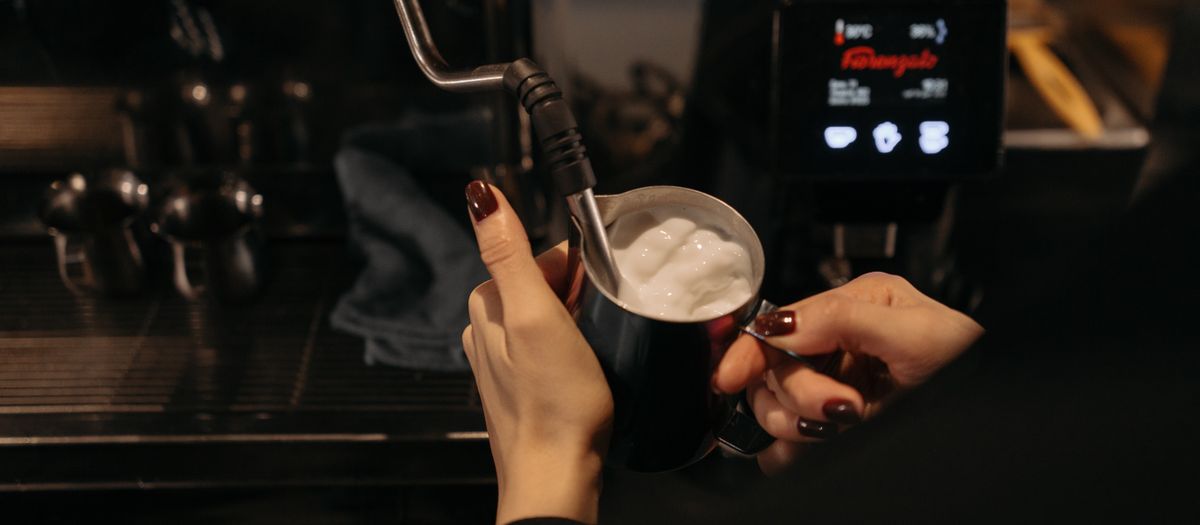
If milk drinks are your thing, it's worth understanding what "good steam" buys you, because it's the half of the drink the spec sheet talks about least. Steam power and steam-tip design decide how quickly and how finely you can texture milk — and texture, not just heat, is what separates flat, bubbly froth from the glossy microfoam that makes a flat white feel café-made. A capable steam wand lets you stretch and spin the milk into that smooth, paint-like texture; an underpowered one leaves you fighting big bubbles and lukewarm milk. The good news is that plenty of mid-range machines steam beautifully, so this is about matching the wand to your drinks rather than chasing the biggest boiler. The milk-drinks guide compares machines on exactly this.
It pairs, of course, with the rest of the chain. Great milk over a sour shot is still a sour drink, so the grinder and your puck prep still come first — milk texture is the finish, not the foundation. Get the shot right, then let the steam make it a latte.
Bringing the choice together
Put the three questions together — your drink type, your volume, and your space — and the right machine usually picks itself. When you're ready to compare specific options, the best espresso machines for milk drinks guide is the place to start if milk is your priority, and the best home espresso machines guide covers the machines silo end to end. Whichever you read, fund the grinder properly — that advice never changes, whatever you drink.
And if "how you drink" turns out to be mostly black coffee, it's worth knowing espresso isn't the only good answer. Our sibling site Pour & Grind makes the case for manual brewing for that style of drinking. For the shot and the steam, though, you're in the right place — this whole site stays on espresso machines.
Featured guides
The current published guides in this silo. More land each batch.
Landing next: Best espresso machine for latte art, Espresso machine for beginners, Best espresso machine for a small kitchen, and Espresso machine for cappuccino.
Frequently asked questions
What espresso machine is best for lattes and cappuccinos?
For milk drinks, prioritise steam power and a boiler architecture that lets you steam without long waits. A heat-exchanger or dual-boiler shines if you pull several milk drinks back-to-back; a single boiler is fine for one or two with a short wait between brewing and steaming.
Do I need a dual boiler if I mostly make milk drinks?
Only if you make several back-to-back. A dual boiler lets you brew and steam at the same time, which saves real time when you are making drinks for more than one person. For one or two milk drinks a day, a single boiler or heat-exchanger handles it comfortably.